Consciousness & Mind
Consciousness as Controlled Hallucination
On this page
Not everyone who says perception is not a window onto reality is an idealist. Anil Seth — Professor of Cognitive and Computational Neuroscience at the University of Sussex, and for years one of the world's most-cited scientists — argues from squarely inside mainstream neuroscience that perception is a kind of hallucination: a controlled one. His work is the physicalist counterweight in this section, and the demonstration that you can take the constructed nature of experience entirely seriously without leaving the physical world behind.
The brain's best guess
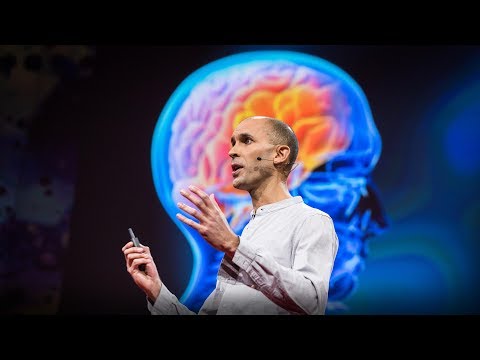
The brain is sealed inside the skull, receiving only ambiguous electrical signals; it never touches the world directly. So perception, on Seth's account, cannot be a passive readout — it must be an active construction, the brain's continuously updated "best guess" about the hidden causes of its sensory inputs. This is the predictive-processing or "Bayesian brain" picture: perception runs largely inside-out, with top-down predictions generating the experienced scene and incoming sensory signals serving mainly as prediction error that reins those predictions in. As he put it in his much-watched 2017 TED talk, "we're all hallucinating all the time; … when we agree about our hallucinations, we call that reality." The word controlled is doing as much work as the word hallucination: because the brain's guesses are constantly corrected by the senses, this is emphatically not the claim that "reality is all in your head."
A controlled hallucination — of a real world
Here is where Seth and the idealists part company, and the contrast is the heart of this section. Both Seth and Donald Hoffman reject naïve realism — the idea that we see the world as it truly is. But they draw opposite conclusions. Seth remains a thoroughgoing physicalist: the brain builds a useful, action-guiding model of a real, mind-independent physical world, so perception is non-veridical yet world-tracking. Hoffman's The Interface Theory of Perception goes further, holding that there is no physical world behind the interface at all, and Kastrup's Analytic Idealism that the ground of everything is mind. Same opening move — perception is a construction — opposite destinations. Seth is the standing proof that abandoning naïve realism does not require abandoning the physical world.
The beast machine
For Seth the self is a controlled hallucination too — and a bodily one. Consciousness, he argues, is bound up less with abstract intelligence than with being alive: the brain's most basic predictive job is regulating the body's internal state — heartbeat, temperature, blood chemistry — and the felt sense of being a self is assembled from the brain's best guesses about those interior signals, tuned for control (staying alive) rather than for accuracy. He turns Descartes on his head: where Descartes dismissed animals as soulless "beast machines," Seth holds that consciousness flows from our nature as living machines — "we are conscious selves precisely because we are beast machines."
The real problem
What of the The Hard Problem of Consciousness — why there is any felt experience at all? Seth neither claims to solve it nor declares it meaningless. He sets it aside in favour of what he calls the "real problem": to explain, predict, and control the specific properties of conscious experience — its level, its content, and the sense of selfhood — in terms of mechanisms in the brain and body. His wager is that as those properties are explained one by one, the hard problem will gradually dissolve the way the old question "what is life?" did once biochemistry filled in the details — and he is candid that this is a research strategy, not a proof.
An honest opponent
Seth keeps this section honest because he defends his rivals' scientific standing even when he thinks they are wrong. When 124 researchers branded Integrated Information Theory "pseudoscience" in 2023, Seth pushed back — not to endorse IIT (he wrote plainly that "IIT is very likely wrong") but to defend its legitimacy as science: "the fact that a theory can have strange, perhaps untestable consequences does not mean that it is pseudoscientific." He polices the boundary of science, not the correctness of his opponents. And he is equally frank about the limits of his own view — that the hard problem is not solved, and that his hunch that consciousness requires a living body is asserted more than demonstrated. His book Being You: A New Science of Consciousness (2021) is the full synthesis.
Sources & talks
His landmark TED talk:
A full lecture tied to Being You:
More: Seth on Sean Carroll's Mindscape, "Emergence, Information, and Consciousness". Primary sources: Anil Seth, Being You: A New Science of Consciousness (2021) · his TED talk and essays (the Aeon "real problem" essay, 2016; the Nautilus "beast machine" essay, 2021) · Seth & Tsakiris, "Being a Beast Machine," Trends in Cognitive Sciences 22 (2018) · and anilseth.com.
Details
- Section:
- Consciousness & Mind
- Updated:
- 2026-06-18
More in this section